

Cardiovascular disease accounts for roughly 32 percent of all global deaths, and beta blockers remain first-line therapy across hypertension, angina, and stable heart failure management, which is exactly why the extended-release beta blocker segment continues to draw steady procurement attention from generic manufacturers worldwide. Finding a reliable metoprolol succinate api exporter matters more for this specific molecule than for many other cardiovascular APIs, because its extended-release performance depends on polymorphic form and particle size characteristics that a standard Certificate of Analysis does not always capture in enough detail to predict dissolution behaviour.
This guide covers what actually differentiates metoprolol succinate from its more commonly confused tartrate counterpart, the specific quality parameters that determine whether a batch performs correctly in an extended-release tablet, realistic capacity and documentation expectations, and the vetting questions that catch a supplier who has not tested what they are claiming.
Metoprolol Succinate: Chemical Profile and Clinical Role
Metoprolol succinate is the succinate salt formulation of metoprolol, a selective beta-1 adrenergic antagonist, engineered specifically for extended-release delivery. Its lower systemic bioavailability relative to the tartrate salt is precisely what enables the sustained, once-daily plasma concentration profile that has made it a preferred formulation choice for chronic cardiovascular therapy.
| Parameter | Value |
| CAS Number | 98418-47-4 |
| Molecular Formula | C34H56N2O10 |
| Molecular Weight | 652.8 g/mol |
| Drug Class | Beta Blocker (Beta-1 Selective) |
| Release Profile | Extended-release |
| Pharmacopoeial Grades | IP, BP, USP, EP |
The extended-release property directly improves patient compliance by reducing dosing frequency, which is part of why clinical guidelines continue to recommend beta blockers like metoprolol succinate as essential therapy for hypertension, angina, and stable symptomatic heart failure of ischemic, hypertensive, or cardiomyopathic origin.
This is also where sourcing confusion most commonly happens. Metoprolol succinate and metoprolol tartrate are chemically related but pharmaceutically distinct products, formulated for different release profiles and rarely interchangeable in a finished dosage form without a full bioequivalence and stability programme. A procurement team that receives a quote simply listed as “metoprolol API” without the salt form specified should treat that as an incomplete quote rather than a starting point for negotiation, since ordering the wrong salt can derail an entire formulation timeline.
The Quality Parameters That Actually Predict ER Performance
The metoprolol succinate API market includes dozens of Indian manufacturers offering the molecule, most with a COA showing assay compliance and a GMP certificate on letterhead. What separates a batch that performs correctly in an extended-release tablet from one that fails dissolution testing during stability studies is a narrower set of parameters that fewer suppliers measure routinely and fewer buyers ask for systematically.
Verify these specifically before committing to a bulk order:
- Assay range specified correctly for your target market: BP/EP requires 99.0 to 101.0 percent on an anhydrous basis for dual US and EU supply, while USP-only supply accepts a wider 98.0 to 102.0 percent range
- XRPD polymorph identity confirmation, since polymorphic form directly affects dissolution rate in ER matrix formulations
- Particle size distribution data specific to the batch, not a general product specification sheet
- ICH Q3A-compliant impurity profiling with actual numeric results, not a “complies” declaration
- ICH Q1A stability data covering both accelerated and long-term storage conditions
Insist that the COA reports the actual numeric percentage measured by HPLC rather than a pass or fail declaration. A supplier unwilling to share the underlying number, only the compliance statement, is withholding exactly the data a formulation scientist needs to troubleshoot a dissolution issue later. It is reasonable to request this data as a condition of moving forward with a paid development sample, since a supplier confident in their own testing has no reason to withhold it.
Export Documentation for Regulated Market Filings
Beyond the technical quality package, an exporter supplying regulated markets needs to demonstrate a working understanding of what each destination regulator actually requires at the border and in the submission file. A Type II USDMF is the standard route for referencing an API in a US ANDA, while an Active Substance Master File serves the equivalent function for EU CTD submissions, and buyers should confirm which route their prospective exporter has actually used successfully rather than which route they claim to support in general terms.
Customs documentation matters just as much as regulatory documentation for keeping a supply chain moving. A complete shipment package should include the Certificate of Analysis matched to the ordered grade, a Certificate of Origin, a Material Safety Data Sheet, and any destination-specific import documentation the buyer’s customs broker requires. Exporters with genuine multi-market experience typically have this packet standardised and ready to issue alongside the shipment rather than assembled reactively after a customs query arrives.
Capacity, Documentation, and Realistic Lead Times
Metoprolol succinate production at commercial Indian facilities commonly runs in the range of high single-digit to low double-digit metric tonnes per month, with actual figures varying by manufacturer and product mix. Buyers should confirm whether quoted capacity reflects dedicated line time for this specific product or shared capacity across a broader beta-blocker portfolio.
| Documentation Item | Why It Matters for This Molecule |
| Batch-specific COA | Confirms actual HPLC assay number, not just pass/fail status |
| XRPD data | Verifies polymorphic form consistency batch to batch |
| Particle size distribution report | Predicts ER matrix dissolution performance |
| ICH Q3A impurity profile | Required for ANDA and EU CTD submissions |
| ICH Q1A stability summary | Supports shelf-life claims on the finished dosage form |
| DMF / ASMF reference letter | Enables referencing in a US or EU regulatory filing |
Standard lead time for stocked, previously qualified grades typically runs two to four weeks, while a first-time custom specification or a smaller regional pharmacopoeial grade can extend to six to eight weeks depending on testing backlog at the supplier’s analytical lab.
Vetting an Exporter Before You Commit to a Program
An exporter relationship for a maintenance cardiovascular API is not a one-time transaction; it is a multi-year supply commitment that a regulatory filing will reference by name. Vetting effort upfront is cheap compared to re-qualifying a new supplier mid-programme.
Ask a prospective exporter directly:
- Can you share the actual assay percentage and XRPD data for a recent commercial batch, not a specification sheet
- Is your DMF currently open and accessible for reference by a buyer’s regulatory team
- What export documentation and customs support do you provide for my specific destination market
- Can you supply a dosage form-specific technical data package before I commit to a development sample
- What is your track record of on-time delivery for repeat commercial orders, not just first samples
A supplier who responds to the first question with hard numbers rather than a marketing description of their quality system has already demonstrated more transparency than most of the market. It is also worth asking how the exporter handles an out-of-specification result internally, since a supplier who cannot describe a documented deviation and corrective action process has likely not been through a real regulatory audit yet.
Why This Segment Rewards a Consolidated Supplier Relationship
The global beta blocker market was valued at over 22 billion US dollars in 2025 and continues expanding at a mid-single-digit compound annual growth rate, with Asia-Pacific commanding the largest regional revenue share, anchored by manufacturing capacity and generic formulation expertise concentrated in India and China. Cardiovascular APIs as a category represent over a quarter of the total global API market, making this one of the more institutionally mature and well-documented therapeutic segments to source from, which works in a buyer’s favour when evaluating supplier documentation maturity.
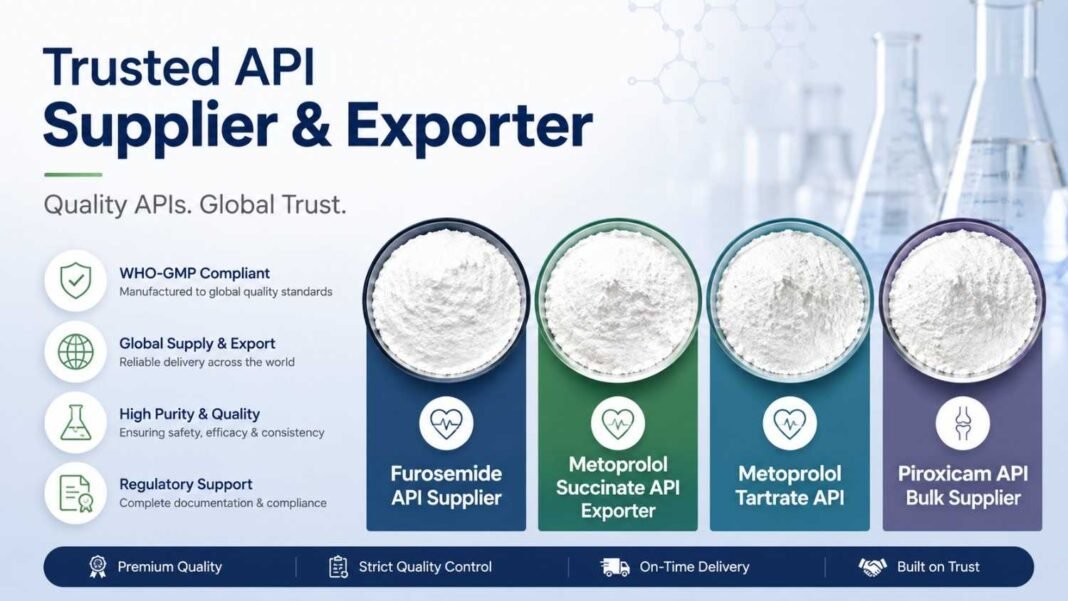
Buyers building a cardiovascular API portfolio benefit from qualifying an exporter who supplies both metoprolol succinate and its tartrate counterpart from the same facility, since it consolidates vendor audits and regulatory documentation management into a single qualification cycle rather than duplicating that effort across separate suppliers for two closely related salts. This consolidation advantage compounds over time: every additional product qualified under one supplier relationship is one fewer facility audit, one fewer set of quality agreements, and one fewer point of failure in an already complex multi-vendor supply chain.
Building a Supply Relationship That Survives a Regulatory Filing
The exporters worth committing to are the ones who volunteer XRPD and particle size data before being asked twice, because that transparency signals a quality system built for extended-release products specifically, not adapted from a generic tablet API workflow. A cheaper quote that cannot produce this data on request is not actually cheaper once a dissolution failure surfaces during stability testing, since reformulation and re-qualification costs on a stalled ER programme routinely dwarf any per-kilogram savings from the original quote.
For procurement teams ready to qualify a documented api bulk manufacturer with a track record across the broader cardiovascular API portfolio, reviewing current capacity, grade availability, and technical documentation before the first sample request is the fastest path to a supply relationship that holds up under regulatory scrutiny.